Connie Coy, president of the board of directors
Connie Coy was elected as President to the board on October 14th, 2025, and since that time, she has violated the rules of the governing documents and Florida law and took actions to undermine the equal authority of the board members, violated the rights of property owners, and acted unethically necessitating her removal as president of the board.
Transparency and openness were prominent themes during Connie Coy's campaign for the Board of Directors. As a result, some owners have expressed concern that the current operation of the ACC does not align with those stated objectives and have called for greater visibility into the committee's activities and decision-making processes.
These circumstances have prompted questions among some property owners regarding Connie Coy's leadership and commitment to the principles of transparency and openness that she publicly advocated. Such concerns arise when board and committee activities are perceived as being conducted without the level of visibility and owner access expected under applicable laws and governing documents.
Ethical and effective governance should not depend upon the threat of legal action to ensure compliance with transparency requirements. Rather, openness, accountability, and adherence to established procedures should be reflected in the board's routine conduct and decision-making processes.
The homeowners' association, including its board of directors, committees, records, and governance processes, exists to serve the interests of the property owners collectively. These association resources and responsibilities are not the personal property of any individual board member, officer, or committee member, but rather are held and administered on behalf of the community in accordance with the governing documents and applicable law.
Board and committee members are entrusted with the responsibility of managing the association's affairs for the benefit of all owners. This responsibility carries with it an obligation to act transparently, follow established procedures, and exercise their authority in a manner that promotes the interests of the community as a whole.
Despite her assurances that her involvement would help promote harmony within the community, many residents believe the opposite has occurred. Rather than reducing divisions, her actions and decisions have, in the view of some owners, contributed to ongoing disagreement and distrust within the community.
Community leadership should be measured by its ability to foster transparency, credibility, and constructive engagement among residents. Critics contend that her conduct has not achieved those objectives and has instead raised concerns regarding consistency, candor, and accountability.
The following examples are provided to document actions and decisions attributed to Connie Coy that have been the subject of owner concerns regarding governance practices, transparency, and compliance with the association's governing documents and applicable legal requirements.
1. Connie Coy has listed her property for sale while refusing to resign from the board.
Connie Coy has listed her property for sale in February 2026 but refuses to resign from the board.
Real Estate Listing for Connie Coy's Property
As the president of the board, since she has made the decision to leave the community, questions naturally arise regarding whether continued service on the Board remains appropriate. Effective community governance is best served by directors who maintain a long-term stake in the community and who will continue to be directly affected by the decisions they make.
Board members are entrusted with acting in the best interests of the association and its property owners. When a director has decided to relocate and no longer intends to remain part of the community, some owners may reasonably question whether that director's priorities remain aligned with the long-term interests of the residents who will continue to live with the consequences of Board decisions.
For this reason, many believe that Connie Coy who has committed to leaving the community should step down from the Board as her board position would better serve the association by allowing another owner with an ongoing investment in the community's future to assume the role.
2. Connie Coy’s ethics of consistency with Board appointment practices.
In August, when the Board sought to fill vacant director positions, board member Robert Henry contacted Greg Coy and invited him to serve on the Board. During that conversation, Greg's wife, Connie Coy, also participated in the phone call and expressed strong opposition to the appointment process. She stated that she and others believed Board vacancies should be filled only through a vote of the membership rather than by Board appointment, despite the governing documents authorizing such appointments and holding a vote would cost over $3,000 and take several months.
During the discussion, Connie characterized Board appointments as "highly unethical" and argued that directors should be elected by the property owners. She specifically referenced the appointments of Robert Henry and Joel Smith to the board, stating that those appointments had upset many members of the community. As a result of these concerns, Greg declined the invitation, stating that he could not accept what he viewed as an unethical appointment.
Approximately two months later, in October, Connie Coy accepted an appointment to the Board when she was offered the same opportunity to serve.
This sequence of events raises questions regarding the consistency of her position taken against Board appointments in August and her subsequent acceptance of a Board appointment later in October.
At the time, these changes in her conduct prompted concerns among some homeowners regarding how she might perform as a member of the Board of Directors and whether her actions reflected the standards of ethics and judgment expected of board members.
3. Connie Coy took unauthorized actions affecting HOA legal proceedings and later misrepresented those actions to the Board.
On November 24, Connie Coy communicated directly with the Association's legal counsel without prior authorization from, or notice to, the Board of Directors. In that communication, she requested that counsel suspend further action on pending litigation matters until the Board had an opportunity to reconsider the matter after the board election to be held in December 2025.
The action was inconsistent with a board-adopted policy designating Lynn Smith as the Board's sole point of contact with the Association's legal counsel, a procedure established to ensure consistent communication and avoid conflicting instructions to counsel.
Connie was asked if she contacted the attorney’s and she claimed she did not.
This is her email dated 4 December stating that, instead, the attorney’s had called her.
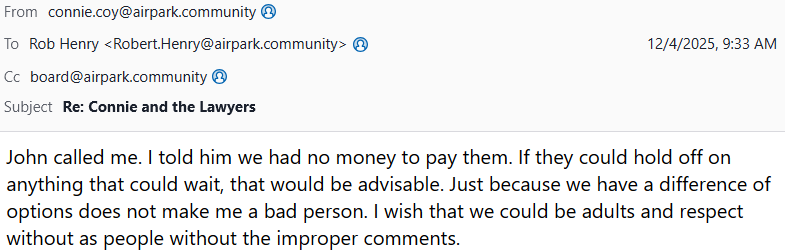
The following email that Connie had sent previoulsy to the attorneys demonstrates that she not telling the entire truth. She had written the attorneys 10 days before she claimed she never contacted them and told them to pause the lawsuits.
Also, please see item #4 below in regard to this email as her email also claims the board was seeking to replace the attorney without her knowledge.

Several board members questioned whether Connie possessed the authority to independently provide direction to the Association's attorneys regarding ongoing legal matters, particularly where such direction had not been authorized by a board vote.
Concerns were also raised that her communication may have affected the Association's handling of pending legal proceedings and could have created uncertainty regarding the Board's previously authorized legal strategy.
4. Connie Coy made false allegations of unethical conduct by the Board.
In one of the legal matters involving the Association, existing counsel advised the Board that a separate attorney should be retained to address a specific aspect of the case due to a potential conflict arising from prior involvement with matters related to the Airpark dating back approximately 20 years.
In response, the Board arranged to consult with additional legal counsel for that limited purpose. Subsequently, as shown in the email in item #3 above, Connie Coy publicly asserted that the Board was attempting to terminate existing counsel and replace the attorney handling the entire case without her participation.
However, the Board's actions were limited to addressing the identified conflict issue, and Connie Coy was invited to participate in the meeting with the prospective attorney but declined to attend due to claims of being out of town at the time. Another new member of the board, Brian McKinney did attend the meeting with the attorney. The meeting was not conducted without the awareness of the Board members, and all Board members were afforded the opportunity to participate.
There was nothing unethical or secretive about the Board's action in the matter.
5. Connie Coy took actions that raised concerns regarding the Board's ability to maintain direct communication with Burg Management.
On December 4, Burg Management informed the Board of Directors that Connie Coy had directed Burg to invoke a previously unused provision of the management agreement designating the Board President as the sole point of contact between the Association and Burg Management if the board did not vote to a point of contact.
For the preceding four years, all members of the Board have maintained direct access to and communication with Burg Management personnel, facilitating collaboration and oversight across board functions. Concerns were raised because this change was implemented without prior discussion or approval by a vote of the Board. The board had the authority to appoint a single point of contact if Burg felt it necessary to have a single point of contact. Connie, however, took it upon herself without board approval to appoint herself as the single point of contact. As a result, direct communication channels previously available to individual board members were restricted. Particular concern was expressed regarding the impact on the Treasurer's ability to communicate directly with account managers and management personnel responsible for the Association's financial matters. Board members noted that direct access to such information and personnel has historically been an important component of effective financial oversight and governance.
This action by Connie Coy was viewed by the other board members as an unethical attempt at control of the board and governance of the community through the Burg property management company. It was also viewed as an ethical and contractual issue by Burg not to notify the board when Connie made the request, further harming the already strained relationship with Burg.
Burg did not notify the board of the change in communication until such time the Town Square forums were place back online and Burg was questioned by the board about it. The following email from Amanda was the only notification given that Burg was no longer communicating with the any board members but Connie.
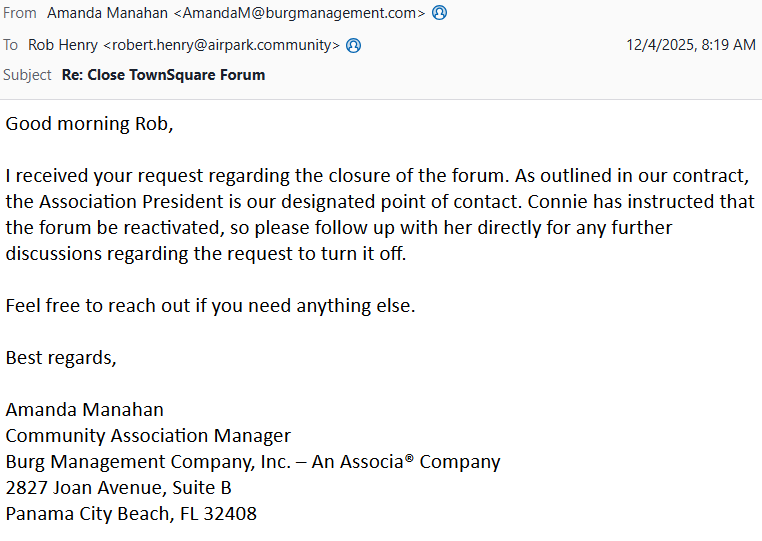
Amanda’s statement does not fully reflect the provisions of the contract.
The contract provides that the Board of Directors may designate a single point of contact if Burg Management requests such an arrangement. However, the authority to make that designation rests with the Board as a whole and requires Board approval. The President does not have unilateral authority to make this determination independently.
Additionally, the contract language does not prohibit communication between Burg Management and individual directors acting within the scope of their respective duties and responsibilities.
The following excerpt from the Burg Management contract addresses the designation of a single point of contact.

6. Connie Coy manipulated owner access to the TownSquare Forums without Board Approval.
The TownSquare forums were intended to provide a space for community members to communicate, exchange information, and engage in constructive discussion. However, when discussions become dominated by disputes, legal disagreements, or other contentious matters, online forums can become less effective in serving the broader interests of the community.
This is a challenge faced by many homeowner associations and community organizations, where the actions of a relatively small number of participants can significantly affect the quality and usefulness of discussions for other residents.
For these reasons, the TownSquare forums were disabled by the Board of Directors, with the support of Burg Management, earlier in 2025.
In December 2025, the board agreed to enable the forums for a few days during the election to allow Jim Pannell access to his bio that he had previously posted to the forums.
Without prior approval or authorization from the Board of Directors, Connie directed Burg Management to re-enable the community forums. Subsequently, when forum discussions began to include critical questions and commentary regarding her actions as Board President, she directed Burg Management to disable the forums once again. These actions were taken unilaterally and without a vote or approval of the board.
She did not consult with the Board of Directors regarding this action, nor did she have the authority to make an independent decision to either keep the forums active or subsequently disable them.
Under Florida HOA governance principles, decisions of this nature are generally matters for the Board acting collectively, rather than for any individual board member acting unilaterally.
The forums are a community resource and are not the property or responsibility of any single director. As such, their management and administration should be determined through the Board's established decision-making processes on behalf of the community.
The fact that Burg management did not seek to ensure her demands were Board approved actions is concerning.
7. Connie Coy attempted to make an unauthorized settlement agreement with the EAA.
In November, Connie Coy conducted a meeting with representatives of the EAA regarding the ongoing litigation involving the organization. She stated that all participants would be informed that the discussion was being recorded to promote transparency and that she would compile and present the EAA's requests, concerns, and proposed terms to the Board of Directors for review and consideration.
Following the meeting, neither the recording nor a comprehensive summary of the EAA's requests and proposals was provided to the Board. As a result, board members were unable to independently review the information discussed during the meeting.
Additionally, no executive session of the Board was convened to discuss the matter. Instead, a proposed agreement prepared by the EAA was provided to only one board member. The Board had not authorized any individual director or officer to negotiate or enter into an agreement on behalf of the Association without board approval.
As a result of these actions, a proposed agreement was developed without full Board review and participation. The agreement is currently undergoing legal review, and concerns have been raised regarding its potential legal and financial implications for the Association.
8. Connie Coy failed to provide the Board with timely notice of the Lot 83 sales contract.
On November 3, the Board voted to proceed with the sale of Lot 83. During the discussion, Connie Coy expressed a preference for using a listing agent with whom she was personally acquainted.
The Board was not informed at that time that the proposed listing agent was a member of the Sandy Creek Airpark community. While there is nothing inherently improper about engaging a qualified listing agent who resides within the community, transparency and full disclosure are important to ensure that potential conflicts of interest are identified and that all interested and qualified parties have an opportunity to be considered.
Several owners and board members later raised concerns that the relationship between Connie Coy and the proposed listing agent should have been disclosed before any contractual discussions took place. These concerns centered on principles of transparency, fairness, and sound governance rather than the qualifications of any particular listing agent.
Additional concerns arose regarding communication of the listing agreement to the Board. Rather than distributing the contract directly to all board members for review, Connie Coy stated that she had provided the document to Burg Management for posting on TownSq at a later date. As a result, board members were not afforded an opportunity to promptly review and discuss the agreement.
Effective board governance depends on timely and open communication among directors. Limiting or delaying access to documents related to significant Association transactions can hinder the Board's ability to exercise its oversight responsibilities and make informed decisions on behalf of the Association.
9. Connie Coy included an unauthorized statement in the annual meeting notice.
For the annual meeting, Connie Coy included a personal statement in the meeting materials that was not disclosed to, reviewed by, or approved by the Board of Directors prior to distribution.
The inclusion of material presented in connection with an official Association meeting without prior board review raised concerns regarding transparency, collaboration, and adherence to established governance procedures.
By distributing the statement without seeking board review or authorization, the Board was not afforded the opportunity to evaluate the content, discuss its appropriateness, or determine whether it accurately reflected the position of the Association. As a result, the Board's collective oversight and decision-making responsibilities were circumvented.
10. Connie Coy's administration of the nomination process raised concerns regarding the exclusion of qualified candidates.
For the 2025 Board of Directors election, three board positions were scheduled to be filled. Connie Coy, president of the board, appointed a nominating committee consisting of Brian McKinney (a sitting board member), Joanne Witzel, and Kim Vogel to assist with the candidate nomination process.
Under the association's governing documents and applicable law, any owner who was current on assessments and otherwise legally eligible to serve was entitled to seek election to the Board of Directors.
Concerns were raised by several owners regarding the manner in which the nominating process was conducted. Specifically, questions were raised as to whether the committee's consideration of potential candidates was focused primarily on individuals personally known to committee members rather than being conducted in a manner that actively encouraged participation by all eligible owners. Additional concerns were expressed regarding certain questions and comments made during candidate discussions that appeared unrelated to the objective qualifications required for board service.
Board members including Lynn Smith and Robert Henry objected to the process and advocated for a broader and more inclusive approach to candidate recruitment and nomination. Their position was that all eligible and interested owners should be afforded an equal opportunity to participate in the election process and to be considered for service on the Board of Directors based solely on the qualifications established by the association's governing documents and applicable law.
During discussions regarding these concerns, committee members and board representatives acknowledged that they had not reviewed the applicable Florida statutes governing homeowners' associations or the association's governing documents relating to the nomination process. Several individuals also stated that they were not attorneys and therefore were uncertain as to the specific legal requirements in what appered to be an attempt at dismissing their ethical responsibilities. Concerns were subsequently raised by owners that board and committee decisions affecting election procedures should be based upon a thorough review and understanding of the governing documents and applicable law to ensure that the rights of all property owners are protected and that the election process is conducted fairly and consistently.
Committee members further indicated their understanding that nomination committee meetings and deliberations were intended to be limited to committee participants and conducted in secret without the presence of the membership. This interpretation raised additional concerns among owners regarding compliance with applicable transparency and open-meeting requirements governing association committees and board-related activities. Owners advocating for greater transparency maintained that committee deliberations affecting the election process should be conducted in accordance with all applicable legal requirements and in a manner that promotes openness, accountability, and confidence in the integrity of the election process.
Concerns were subsequently raised that board and committee decisions affecting election procedures should be based upon a thorough review and understanding of the governing documents and applicable law to ensure that the rights of all property owners are protected and that the election process is conducted fairly, transparently, and consistently.
11. Connie Coy violated the covenants while demanding other property owners be held to the covenants.
The Association's governing documents prohibit the keeping of chickens on properties within the community. Questions have been raised regarding compliance with this restriction, as chickens reportedly remained on Connie Coy's property after she stated that they had been removed.
Additional concerns have been expressed regarding compliance with other Association requirements. These include the completion of required landscaping after the prescribed deadline and allegations that certain aspects of the property's construction differ from the plans submitted for Association review and approval.
At the same time, Connie Coy has participated in Board actions involving covenant enforcement against other property owners, including the issuance of violation notices. Some residents have questioned whether Association rules and standards are being applied consistently and equally to all owners, by excluding members of the Board from enforcement.
These concerns have led some owners to call for greater transparency, accountability, and uniform enforcement of the governing documents throughout the community.
12. Connie Coy holds Architectural Control Committee (ACC) board meetings in secret, violating owner rights and the law.
The Architectural Control Committee (ACC), whose members were appointed by the Board of Directors, including Connie's husband Greg Coy, has been the subject of concerns regarding its compliance with Florida law and the requirements of Florida HOA law Chapter 720. These concerns include whether committee meetings are conducted openly and whether records and documentation are made available in accordance with applicable legal requirements.
Committees established by the Board of Directors are expected to operate in accordance with Florida law and the association's governing documents. These requirements are intended to promote transparency, accountability, and owner participation in association governance, ensuring that committee activities are conducted openly and in a manner consistent with the same standards applicable to the board.
During a board meeting, Greg Coy expressed the position that the ACC is not required to conduct open meetings, discuss approval decisions in a public forum, or provide certain committee documentation. This interpretation has been questioned by some property owners who believe greater transparency and access to records are required.